
It's the most common reason couples stop training together: one of you is faster, stronger or simply more used to it. The fitter partner feels held back, the newer one feels like they're slowing everyone down, and after two weeks you're back to training alone.
It doesn't have to go that way. You don't need to be on the same level to work out together. You need the same time, not the same workout.
The one rule: same session, your own effort
Train at the same time and place, but let each of you work at your own level. The goal isn't to match each other's pace. It's that you both finish the session tired in a good way.
An easy way to check you're each at the right effort is the talk test:
- Easy: you can talk in full sentences.
- Moderate: you can talk, but not sing.
- Hard: you can only say a few words at a time.
Agree on the effort for the session ("today is moderate"), then each of you finds it at your own speed. Moderate for one of you might be a jog; for the other, a brisk walk.
Set separate targets
Comparing numbers is what makes training together feel unfair. Give yourselves different targets instead:
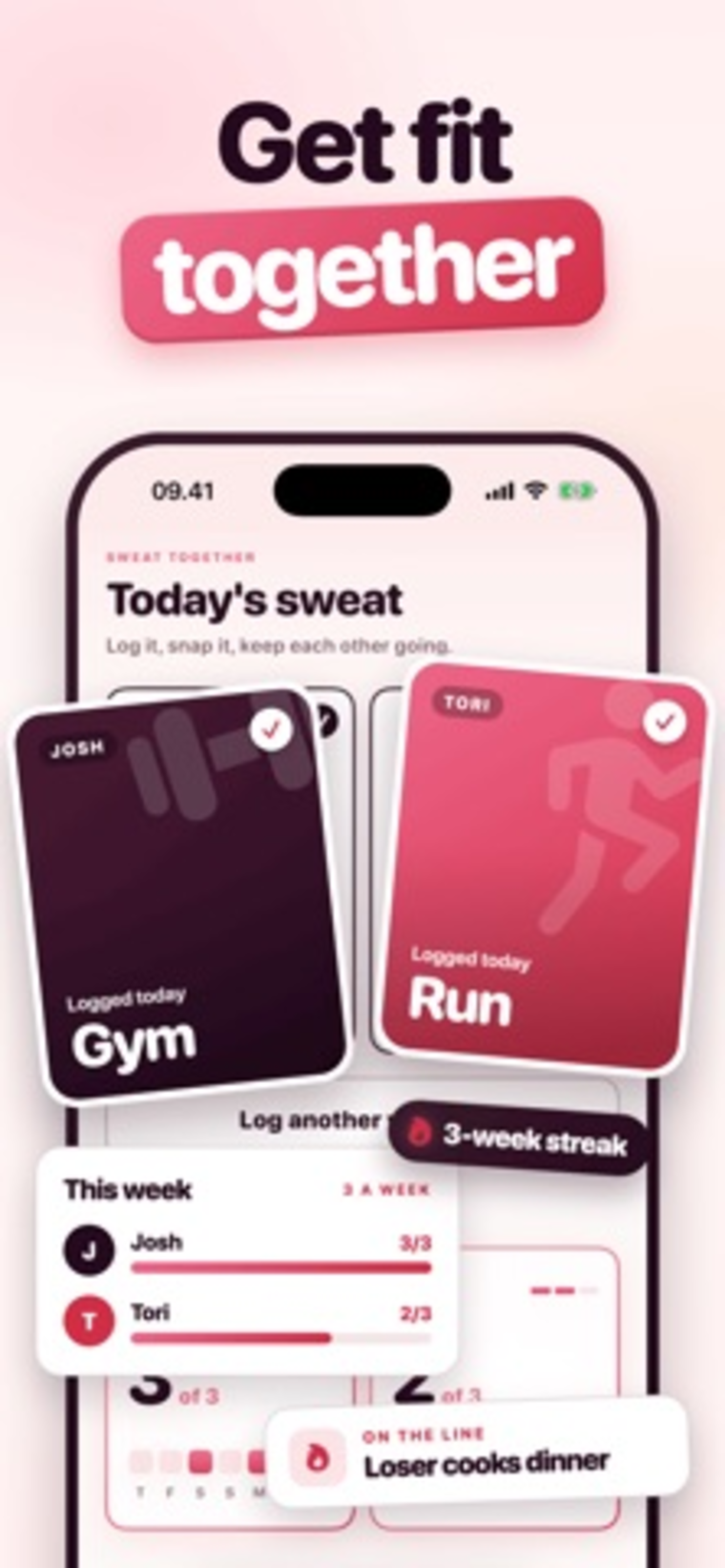
- Weekly days: the newer partner starts at 2–3 days a week, the fitter one keeps their usual 4–5. In Heartpair, each of you sets your own weekly target and the shared streak grows when you both hit yours.
- Distance or reps: pick a number that's a stretch for each of you, not the same number.
- Progress: add a little every week or two, each from your own starting point.
That way, a week where you both hit your own target counts as a win for both of you, whoever ran further.
6 workouts that work on different levels
| Workout | How it works | Why it's fair |
|---|---|---|
| You go, I go intervals | One works for 40 seconds while the other rests, then swap | Each of you picks your own exercise and intensity |
| Same time, own reps | Set a 12-minute timer and do as many rounds as you can of 3 moves | Everyone finishes at the same moment |
| Out and back | Run or walk out in opposite directions for 15 minutes, turn and meet in the middle | The faster one simply goes further |
| Run-walk together | The newer partner alternates running and walking; the fitter one runs loops around them or adds a weighted vest | Same route, same start and finish |
| Strength, two versions | Same exercise, different variation: push-ups vs. incline push-ups, squats vs. weighted squats | You can stay side by side and count reps together |
| Partner hold | One holds a plank or wall sit while the other does reps; swap when the reps are done | The stronger one does more reps, the other holds longer |
Compete on consistency, not performance
If one of you is much fitter, a race on speed or weight is over before it starts. Compete on what you both control: showing up.
- Who logs every planned workout this week?
- Who keeps their weekly target for four weeks in a row?
- Add a fun stake to it with fitness bets for couples: the loser cooks dinner.
The newer partner has just as much chance of winning, and it rewards exactly the habit that gets them fitter.
If you're the fitter one
- Don't coach unless you're asked. Unrequested tips on form or pace are the quickest way to make training together feel like a test.
- Train your hard sessions alone. Keep one or two sessions a week for your own goals, and make the shared ones about being together.
- Go first on the boring parts. Warm up together, stretch together, and let the shared part be the fun part.
If you're the newer one
- Pick your own effort, every time. Use the talk test and ignore their pace.
- Count your own progress. Compare yourself with yourself last month, not with your partner today.
- Suggest the workout sometimes. If you choose a class or activity you like, you won't always be the one catching up.
A simple first week
- Monday: 20-minute walk or easy jog together (easy effort)
- Wednesday: 12-minute "same time, own reps" at home
- Saturday: out-and-back run or walk, then breakfast together
- Anytime: the fitter partner adds one solo session
Log each one so you can see each other's week. See how to get fit together for a full 8-week plan, and 25 couples workout ideas when you want something new.
If either of you has a health condition, an injury or hasn't exercised in a long time, check with your doctor before starting.
FAQ
Can couples work out together if one is fitter?
Yes. Train at the same time but at your own effort: the fitter partner goes faster or further, the newer partner works at a level that's right for them. Intervals, timed rounds and out-and-back routes all work well.
Should we have the same workout goals?
No. Set separate targets, such as days per week or reps, each from your own starting point, and count it as a win when you both hit yours.
How do we stop it feeling unfair?
Compete on consistency instead of performance: who shows up for every planned workout. Both of you have the same chance of winning.
How hard should a shared workout be?
Use the talk test: easy means you can talk in full sentences, moderate means you can talk but not sing, hard means only a few words at a time. Agree the effort, then each find it at your own pace.